Water is the most efficient refrigerant in nature. High-pressure misting exploits a purely physical process — adiabatic evaporative cooling — to lower air temperature without spending energy to produce cold.
Q = m · L
Evaporating 1 kg of water at 20°C requires about 2,450 kJ — latent heat drawn entirely from the air, which cools down.
Twb = f(Tair, RH)
The physical limit is the wet-bulb temperature. Well-designed systems reach 90–95% of the theoretical drop.
THE FIVE PRINCIPLES
The physics, step by step
1. What “adiabatic” means
A process is adiabatic when it happens with no heat exchange with the outside: the air itself gives up heat to evaporate the water. No compressor, no refrigerant gas.
2. Latent heat
Evaporating 1 kg of water at 20°C takes about 2,450 kJ, drawn from the air, which cools. Droplets of 5 to 20 µm create an enormous exchange surface.
3. Why high pressure
At 70–100 bar, nozzles produce sub-10 µm droplets that evaporate before touching any surface: this is dry fog.
4. Wet-bulb temperature
This is the physical limit and depends on temperature and humidity. In hot, dry climates efficacy is highest: 90–95% of the theoretical drop is reached.
5. Humidity and comfort
With sub-10 µm droplets the humidity increase is negligible and often beneficial. Proper engineering keeps values comfortable.
DATA AND CHARTS
Cooling, in numbers
Two tools to understand how much misting delivers in the real conditions of your system.
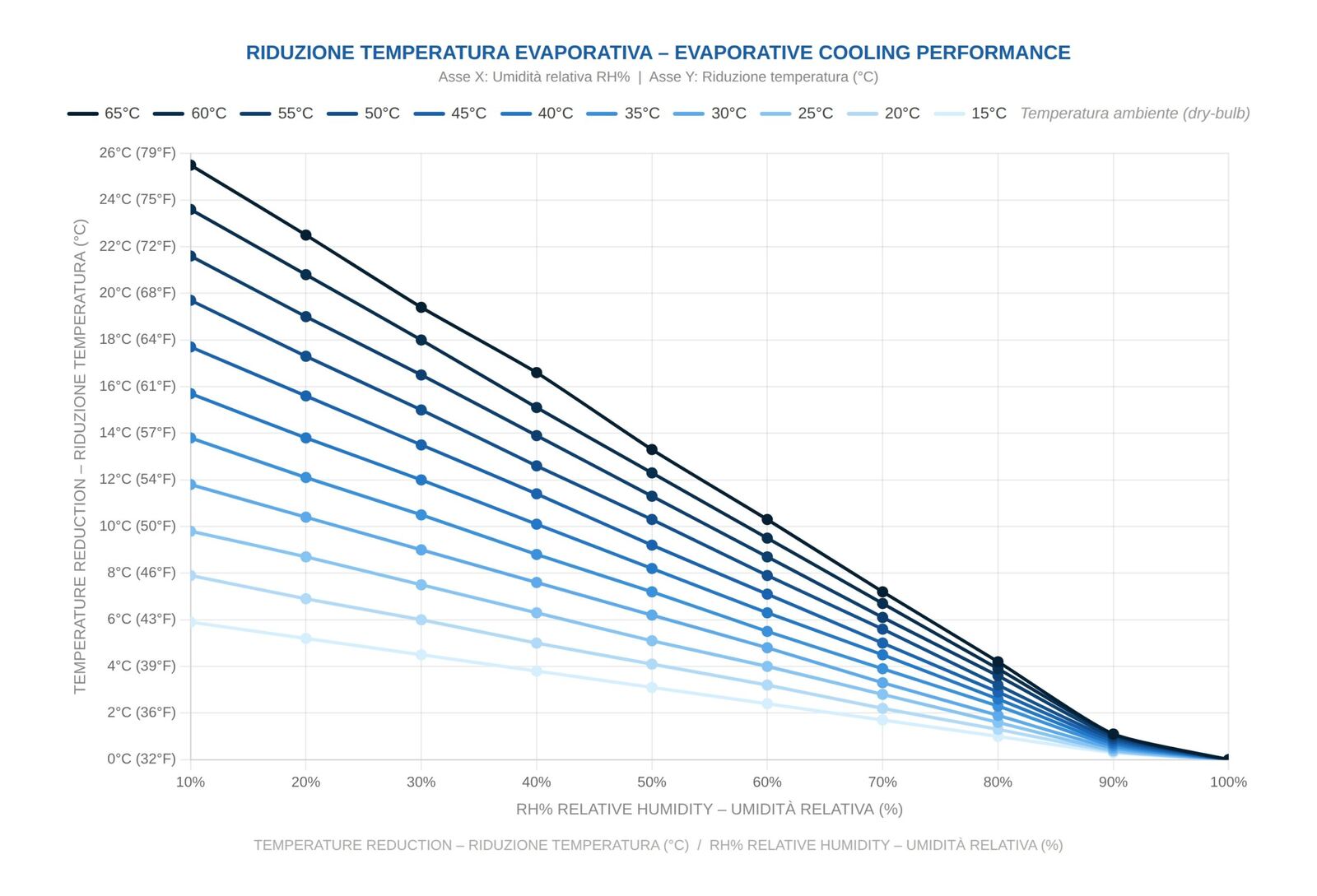
Achievable cooling
How far the temperature drops as a function of relative humidity: the drier the air, the greater the achievable reduction. Each curve represents a different starting condition.
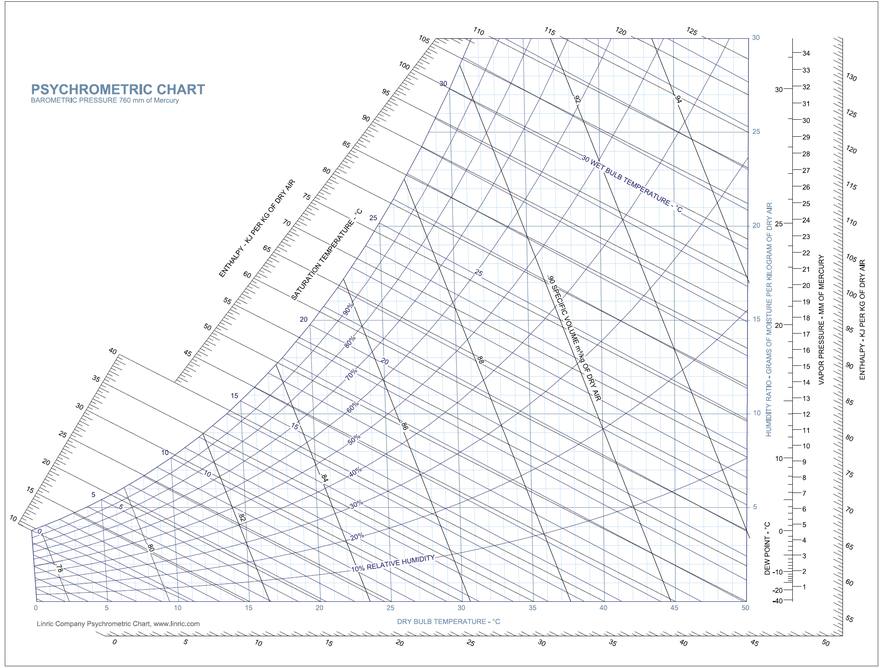
Psychrometric chart
The thermodynamic map of moist air: dry-bulb temperature, humidity ratio and relative-humidity curves. Adiabatic cooling moves along the lines of constant enthalpy.