DUST SUPPRESSION
Dust suppression and air quality
The particles gain weight, they fall — without wetting
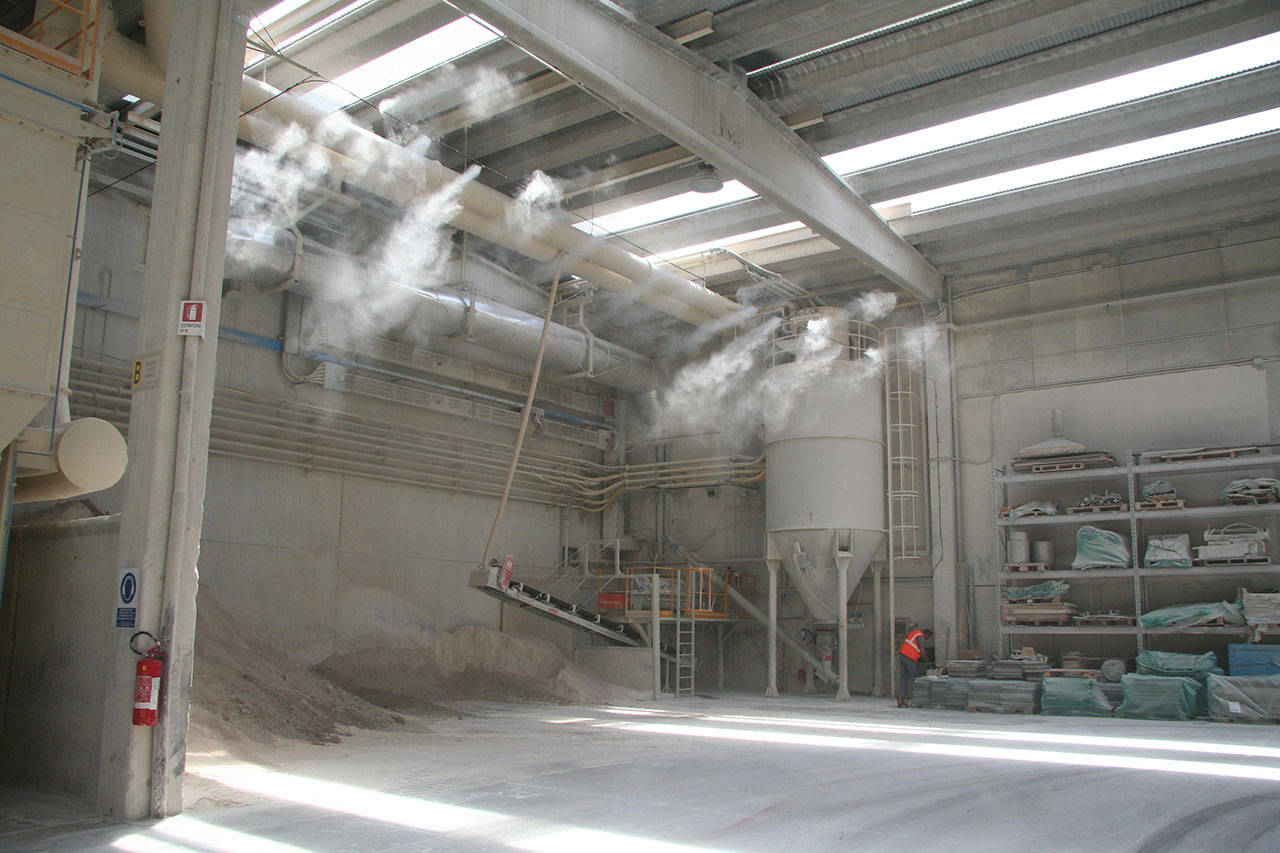
The high-pressure adiabatic system generates ultrafine droplets under 10 µm in diameter — on the same dimensional scale as PM10 and PM2.5 dust particles. In the air, these micro-droplets collide with suspended solid particles through inertial impaction and Brownian diffusion: every dust particle agglomerates with one or more droplets, gaining mass and becoming too heavy to remain airborne.
The result is accelerated, natural settling of dust, with no chemicals, no filters to dispose of and no wetting of surfaces, machinery or materials. Field-measured reductions range from −60% for the finest fractions (PM2.5) to −90% for total suspended particulate (TSP), peaking at −95% for coarse PM10 dust in confined environments.
- TSP (total suspended particulate)−70 / −80%
- PM10−60 / −85%
- PM2.5−40 / −70%
- Mineral dust−80 / −95%
- Operating pressure70 – 100 bar
- EngineeringCustomisable layout
IN DEPTH
Hygroscopic agglomeration — Stokes’ law
Scientific note
Note 1 — Stokes’ law
v_s ∝ d² → ×16 if d doubles
Stokes settling velocity is proportional to the square of the particle diameter. A PM2.5 particle (2.5 µm) that agglomerates with a droplet and becomes 10 µm increases its settling velocity 16-fold. At 20 µm, the increase is 64-fold. Suppression is therefore a physical phenomenon guaranteed by fluid mechanics.
Scientific note
Note 2 — Inertial impaction
E_imp = St² / (St + 0.25)²
Capture efficiency by inertial impaction (E_imp) is a function of the Stokes number. For PM5–PM15 particles in the presence of 8–12 µm droplets, E_imp reaches 40–70%. Brownian diffusion completes the capture of submicron fractions.
Scientific note
Note 3 — No wetting
droplet d < 10 µm → t_evap < 0.3 s
The evaporation time of a spherical droplet is proportional to d². An 8 µm droplet evaporates completely in air at 25°C/50% RH in under 0.3 seconds, travelling less than 20 cm from the nozzle before it disappears or binds to a particle. Wetting is physically impossible as long as the RH set-point stays below 90%.
KEY ADVANTAGES
Why choose it
No chemicals
Just atomised water. No reagents, no special waste, full environmental and permitting compliance.
PM10 / PM2.5 suppression
Reduction certifiable under EN ISO 15767 and local particulate-emission regulations.
Modular installation
Track-mounted ramps, perimeter rings, fixed or mobile lances: any plant geometry can be engineered without invasive structures.
Accelerated settling
Agglomeration brings particles to 10–20 µm, multiplying settling velocity by 16–64 times.
Does not wet surfaces
Sub-10 µm droplets evaporate in under 0.3 seconds: machinery, materials and floors stay dry.
No filters to dispose of
Suppression happens in the air: no filter media to replace, manage or dispose of as waste.
TYPICAL APPLICATIONS
Quarries and crushers
Cement plants
Steelworks
Recycling plants
Construction sites
Bulk handling
Want to evaluate this solution?
We engineer the system around your site: analysis, sizing and a dedicated quote.