PRE-COOLING
Energy efficiency — Pre-cooling
Cooling the intake air means producing more energy
Thermodynamic machines — gas turbines, chillers, condensers, internal-combustion engines — see their efficiency degrade significantly as intake air temperature rises. A gas turbine designed to operate at 15°C ISO loses 0.5–0.8% of output for every degree Celsius of additional ambient temperature, with output drops of up to 20–25% on the hottest summer days.
- Turbine output recovery+12 / +20 %
- Chiller COP improvement+2 / +4 % /°C
- Heat-rate reduction−0.3 / −0.5 % /°C
- Typical payback6 – 24 months
- Operating pressure70 – 100 bar
- ImpactNon-invasive installation
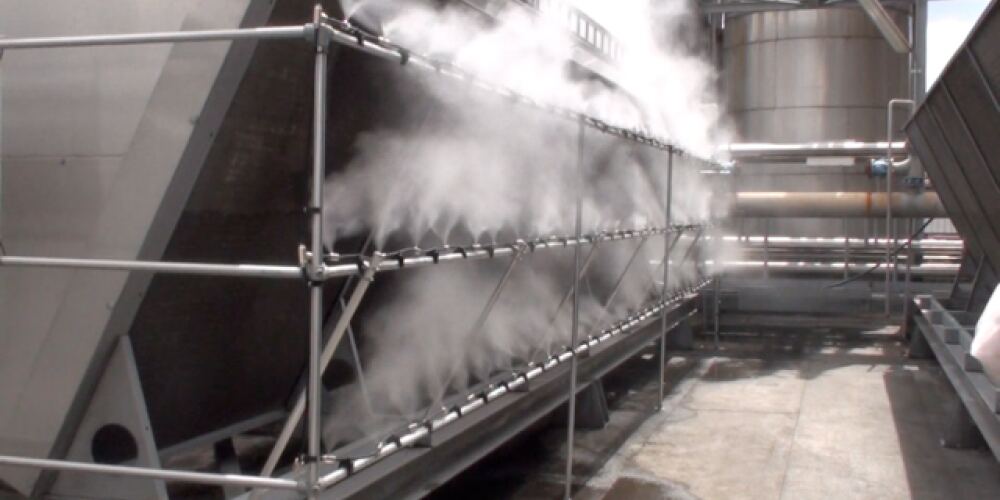
The high-pressure adiabatic pre-cooling system cools the intake air — or the process air — by exploiting the instant evaporation of atomised micro-droplets. The heat required for evaporation is drawn from the air itself (an adiabatic process), bringing the temperature at the machine inlet back towards ISO design conditions with an efficiency recovery of +8/+20%.
IN DEPTH
The thermodynamics of recovery
Scientific note
Note 1 — Turbines
ΔP ≈ −0.54% / +1°C inlet
According to ISO 13686 and GE Gas Turbine Performance Characteristics, the output of a gas turbine falls on average by 0.5–0.8% for every degree Celsius above the design point (ISO: 15°C, 60% RH, 1013 mbar). At 40°C, a 100 MW turbine produces roughly 80–82 MW. Adiabatic pre-cooling to 22°C recovers 12–15 MW for a plant investment of 1–3% of annual revenue.
Scientific note
Note 2 — Chillers
COP = Q_c / W_comp = f(T_cond)
The COP of a compression chiller falls by 2–4% for every degree Celsius of increase in condenser temperature. Cooling the condensing air from 40°C to 28°C with adiabatic pre-cooling improves COP by 15–25%, with direct energy savings of 0.08–0.15 kWh per kWh of cooling produced.
Scientific note
Note 3 — Solar PV
PV efficiency ↓ −0.45% / +1°C panel
Crystalline-silicon PV panels lose conversion efficiency at 0.4–0.5%/°C above 25°C STC. At 70°C (a typical summer cell temperature), the loss is 18–22%. Misting over the module surfaces (evaporation, not wetting) lowers cell temperature by 15–20°C, recovering 7–10% of electricity output.
KEY ADVANTAGES
Why choose it
Fast, measurable ROI
The energy saving is directly quantifiable: kWh recovered × energy cost. Typical payback 6–18 months at current tariffs.
Non-invasive installation
No modification to existing machines. Misting ramps on intake plenums or heat exchangers can be installed in 1–3 days.
CO₂ emission savings
Every kWh recovered is equivalent to roughly 0.3–0.4 kg of CO₂ avoided. For a 50 MW plant, an estimated 2,000–4,000 tonnes of CO₂ per year.
Solar PV application
Misting over PV panels lowers cell temperature by 15–20°C, recovering 7–10% of generation during the hottest hours, with zero visual impact.
Summer peak management
The summer degradation of machines coincides with peak energy prices. Adiabatic pre-cooling acts precisely in the hours of greatest economic value.
Renewable energy
The consumption of the HP system (pump) can be fully powered by PV, making the efficiency gain carbon-neutral for the site.
TYPICAL APPLICATIONS
Gas turbines
Condensers
Chillers
Power plants
PV panels
Want to evaluate this solution?
We engineer the system around your production site: analysis, sizing and an estimate of the return on investment.