WINE CELLARS
Professional humidity control for wine cellars
“The Angels’ Share” — given back to producers
In the cellar it is called “the angels’ share”: the annual evaporation of wine through the staves of the barrel. In conditions of insufficient humidity (<55% RH), a 225 L barrique can lose 3–5% of its volume per year — between 7 and 12 litres of premium product evaporated, over-concentrating tannins and alcohol.
- Target humidity range70–80% RH
- RH accuracy± 2 %
- Target temperature12–16°C
- Evaporation reduction−50 / −70%
- Operating pressure70 – 100 bar
- ControlT/RH probes
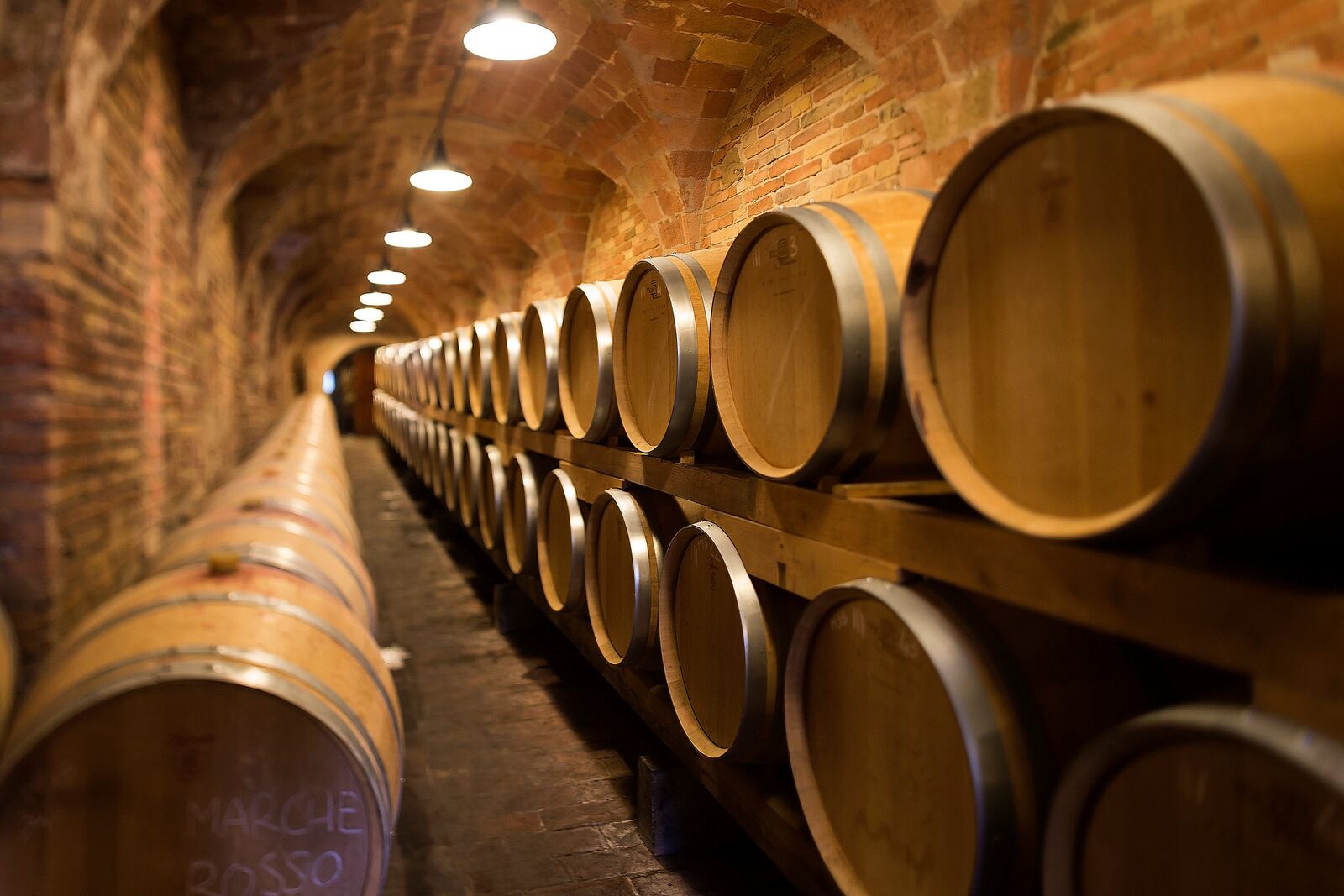
The AQUASPHERE system holds the cellar’s relative humidity in the optimal window of 70–80% RH with a stable temperature of 12–16°C. Losses fall to 1–1.5% per year, protecting the oenological capital, maintaining organoleptic balance and preserving the cork stoppers from drying out.
THE ANGELS’ SHARE — EVAPORATION VS. RELATIVE HUMIDITY
How much wine is lost, and how much is recovered
Insufficient humidity (<55%)
−4 / −5% per year
- •Dried cork, accelerated oxidation
- •Unbalanced tannins, significant volume loss
- •Compromised wine quality
With the AQUASPHERE system
(70–80%)
−1 / −1.5% per year
- •Balanced ageing, elastic cork, perfect seal
- •Evaporation reduced by 60–70%
- •Soft tannins, acidity preserved
Saving on 500 barriques
+3,500 L/year
- •Difference between RH 45% and RH 75% across 500 barriques of 225 L
- •About 3,500 litres of premium product recovered every season
- •Direct ROI in oenological value
IN DEPTH
The physics behind the angels’ share
Scientific note
Fick’s law and diffusion through the stave
J = −D × (dC/dx)
Wine loss from the barrel follows Fick’s First Law of diffusion, where J is the vapour flux, D the diffusion coefficient in oak and dC/dx the concentration gradient between wine and environment. Raising the relative humidity of the air reduces the gradient and therefore the evaporative flux. At RH 75%, the vapour-pressure differential is 65% lower than at RH 45%, with a proportional reduction in evaporation. A temperature of 12–14°C minimises D, further slowing diffusion and preserving volatile aromatic compounds.
Scientific note
Humidity and cork preservation
Cork is composed of suberin (a lipid polymer) that retains elasticity and impermeability only with adequate ambient humidity. Below 55% RH the stopper loses plasticity, shrinks and allows air ingress: the result is premature oxidation of the wine and reductive off-flavours. The 70–80% RH window guarantees the structural integrity of the stopper throughout ageing, which in a great wine can last 18–36 months in barrique.
KEY ADVANTAGES
Why choose it
Reduces evaporation
From RH 45% to RH 75%: 60–70% saving on the volume lost to evaporation. Direct ROI in oenological value.
No condensation
Sub-10 µm droplets evaporate before settling. No droplets on the barrels, no risk of mould from direct wetting.
Eco-sustainable
No refrigerant gas. Just pure water. Environmental impact and carbon footprint reduced to a minimum.
Preserves the cork
The 70–80% RH window maintains the elasticity and seal of the stopper throughout ageing.
±2% RH accuracy
T/RH probes and automatic regulation keep the cellar in the optimal range all year round.
Organoleptic balance
Less forced concentration of tannins and alcohol: the wine’s aromatic profile stays true to the oenological design.
TYPICAL APPLICATIONS
Ageing cellars
Barrique rooms
Cask cellars
Wine shops
Distilleries
Want to evaluate this solution?
We engineer the system around your cellar: analysis, sizing and a dedicated quote.