COOLING AND HUMIDITY CONTROL FOR GREENHOUSES
Microclimate control for professional greenhouses
Perfect temperature, controlled humidity. The plant at the centre.
In protected crops, VPD (Vapour Pressure Deficit) control is the key parameter of productivity: every crop has an optimal vapour-pressure-deficit window outside which the stomata close, photosynthesis slows and yield collapses. The high-pressure system holds temperature and relative humidity within precise ranges, correcting VPD in real time.
- Temperature reduction−8/−12°C
- Humidity range60–98% RH
- RH accuracy± 2 %
- Operating pressure70–100 bar
- Droplet size< 10 µm
- ControlT/RH probes
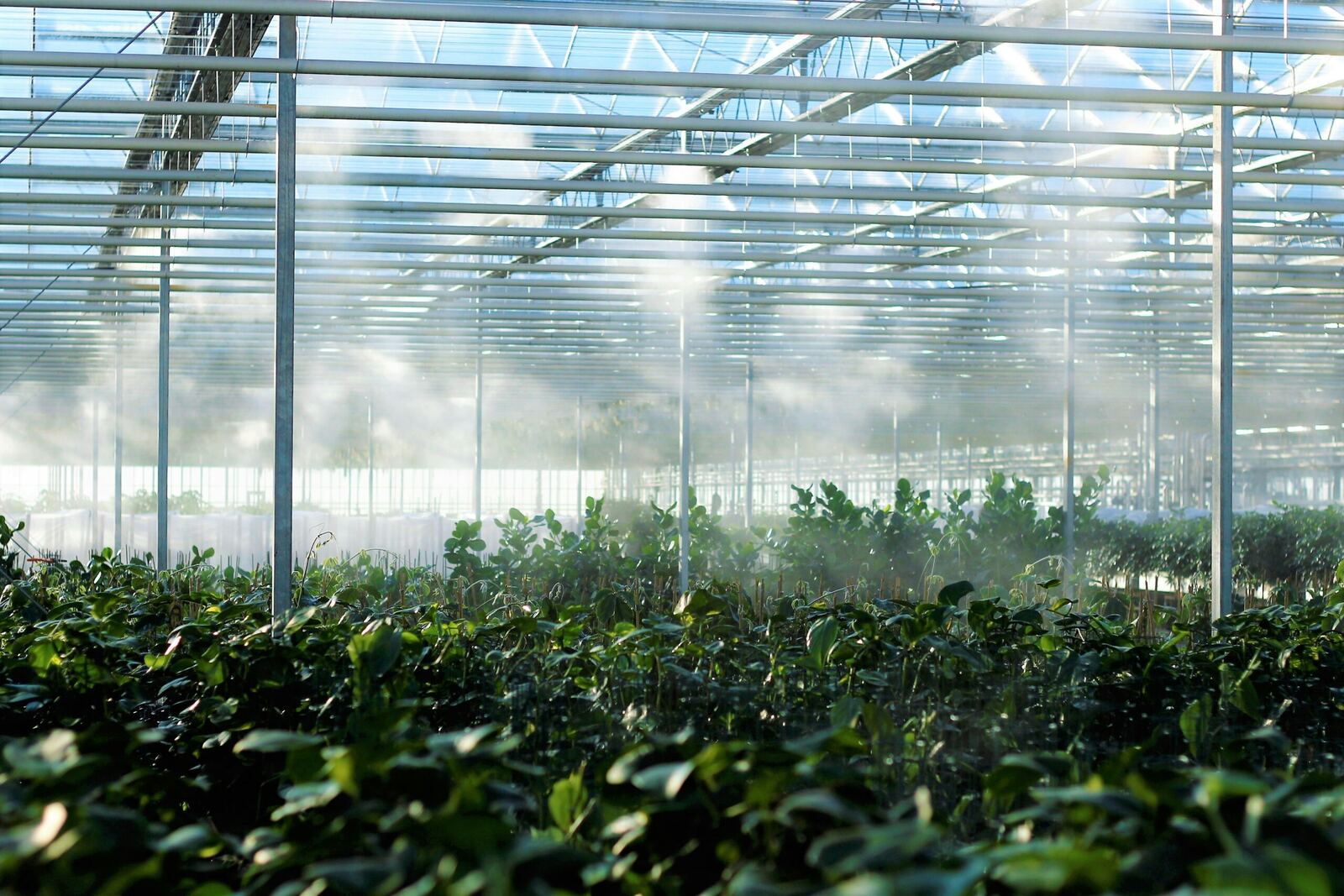
In summer, evaporative cooling lowers air temperature by 8–12°C without soaking the foliage. In dry periods, misting raises RH to 90–95% in gradual steps managed by probes, protecting crops from excessive transpiration and heat stress.
APPLICATIONS BY CROP
Every crop, its optimal window
Ornamental greenhouses Roses · Orchids · Gerberas · Tulips
VPD control widens the flowering window and improves yield per stem. Fine fog prevents leaf scorch in the summer months. +20/35% marketable flowers compared with unconditioned greenhouses; significant reduction of botrytis under stable humidity.
Vegetables Tomato · Pepper · Lettuce · Basil
In summer without cooling, indoor temperature exceeds 40°C: tomato production collapses above 35°C. The system keeps plants in their optimal window. Yield increase of up to 40% in the hot season; more continuous production cycles.
Mushroom farms Button · Shiitake · Oyster · Porcini
Mushrooms require very high humidity and a low, stable temperature. The HP system delivers RH close to saturation with no risk of water stagnation. 30–50% reduction in fruiting-body losses; regular production cycles all year round.
Hydroponics and Aeroponics Lettuce · Strawberries · Microgreens
In closed systems humidity control is critical: a VPD that is too low slows root water uptake. The HP system also integrates root misting in aeroponics. Production cycle shortened by 15–20%; lower total water consumption.
Scientific note
VPD as the engine of growth
Vapour Pressure Deficit (kPa) measures the “thirst” of the air.
Outside the optimal window (0.4–1.6 kPa) the stomata close to reduce transpiration, interrupting gas exchange and therefore photosynthesis. The HP system acts on T and RH in real time, keeping VPD in the productive range regardless of outside conditions.
Studies on greenhouse tomato crops show production increases of 18–40% with controlled VPD versus an unconditioned greenhouse.
KEY ADVANTAGES
Why choose it
No wetting
Sub-10 µm micro-droplets: evaporation before contact. Zero risk of leaf rot or fungal disease from surface moisture.
Scalable and modular
Rapid installation on existing structures. Expandable across zones and different crops with independent control per sector.
Eco-sustainable
No refrigerant gas. Just pure water. Environmental impact and carbon footprint reduced to a minimum.
Real-time VPD control
T/RH probes and automatic regulation keep the crop inside its optimal vapour-pressure-deficit window.
±2% RH accuracy
The humidity set-point is reached in gradual steps, with no swings that could harm the crop.
Higher yields
Up to +18–40% output with controlled VPD and more regular production cycles throughout the year.
TYPICAL APPLICATIONS
Floriculture
Vegetables
Mushroom farms
Hydroponics
Aeroponics
Nurseries
Want to evaluate this solution?
We engineer the system around your greenhouse: analysis, sizing and a dedicated quote.